Mold Inspection and Testing Services
Certified mold inspection across Ontario and Quebec. Infrared imaging, accredited lab analysis, and your report in 24 hours.
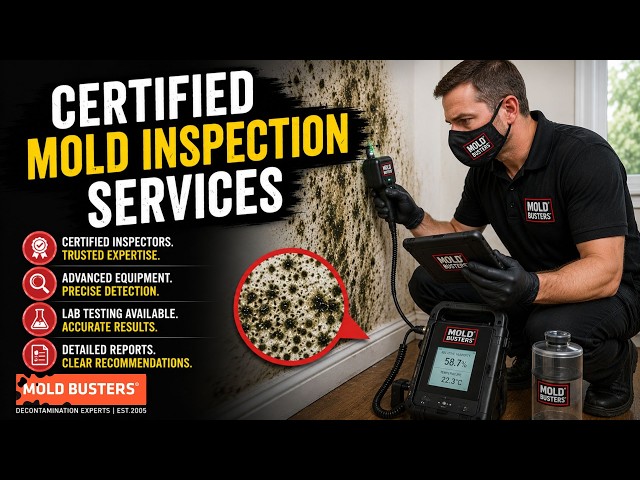
🏅 IICRC Certified 🏅 RBQ Licensed 🔬 Accredited Lab Analysis ⏳ Report in 24 Hours


Certified Mold Inspection Across Ontario and Quebec
A mold inspection is a structured assessment of a building to find mold growth, identify the moisture source feeding it, and document the extent of the problem in a written report. It is the step that tells you what you are actually dealing with before anyone quotes you for removal.
Mold Busters has been doing this since 2005. Our inspectors have completed more than 15,000 inspections across Ontario and Quebec, and the approach has not changed: find the water first, then the mold, then write down exactly what we found. We are IICRC certified, RBQ licensed for work in Quebec, and members of NAMP. Certifications are listed on our certifications page.
We do not sell remediation off the back of an inspection you did not need. If your property is clean, the report says so. That is the whole point of an unbiased assessment.
Accredited lab analysis
Air and surface samples go to government-accredited third-party laboratories. We do not analyse our own samples.
Diagnostic equipment
Infrared thermal cameras and moisture meters find wet material behind finishes, before mold becomes visible.
Report in 24 hours
Written findings within one business day of the visit. Lab results follow when sampling is done.
Available 24/7
Customer service answers around the clock. Call 1-877-566-6653 any time.
Where Do You Need a Mold Inspection?
We inspect properties across both provinces. Pick your area for local details, or book a free inspection and we will route it for you.
Ontario
Ottawa and the surrounding region, Eastern Ontario, and the Greater Toronto Area. See what an Ottawa mold inspection and testing appointment includes, from sampling method to written report.
Ottawa, Kanata, Nepean, Orleans, Stittsville, Kingston, Belleville, Brockville, Cornwall, Carleton Place, Smiths Falls, Toronto, Hamilton, Oakville, Mississauga
Quebec
Greater Montreal, the South Shore, Laval, and the Outaouais.
Montreal, Gatineau, Laval, Brossard, Longueuil, West Island, Dorval, Terrebonne, Mirabel, Mount Royal, Westmount, Salaberry-de-Valleyfield
Not on the list? We cover more of both provinces than we can fit here. Call 1-877-566-6653 and we will tell you straight away whether we can reach you.
What Happens During a Mold Inspection?
A mold inspection follows five steps: an interview about the history of the problem, a full visual assessment, moisture and thermal diagnostics, sampling where it is warranted, and a written report with findings and recommendations. A typical residential inspection takes two to four hours on site.
We ask what happened
Before looking at anything, the inspector asks about leaks, floods, renovations, smells, and when you first noticed a problem. Mold is a symptom of water. The history usually points at the source faster than the instruments do.
Full visual assessment
We work through the property room by room, including the areas people skip: crawlspaces, attics, behind appliances, under sinks, around window frames, and the base of exterior walls. We also note conditions that will cause mold later, such as missing vapour barriers or unvented bathroom fans.
Moisture and thermal diagnostics
Infrared thermal cameras show temperature differences that reveal wet material behind drywall, tile, and insulation. Moisture meters then confirm the actual moisture content of the material. This is how we find hidden growth without opening walls unnecessarily. See our infrared inspection service for how the thermal imaging works.

Sampling, when it is warranted
If you need to know the species or the airborne spore concentration, we take air or surface samples and send them to a government-accredited third-party laboratory. We do not sample every job by default, because a visible patch of mold on a wet wall does not need a lab to confirm it exists. Details on mold testing and air quality testing for mold.


Written report within 24 hours
You get the report within one business day of the visit. Lab results are added when they come back from the laboratory. What the report contains is set out in the next section.


How Long Does a Mold Inspection Take?
Most residential mold inspections take two to four hours on site. Larger buildings, multi-unit properties, and cases with several affected areas take longer, and occasionally need a follow-up visit.
The written report reaches you within 24 hours of the visit. If we took samples, laboratory analysis typically adds a further two to five business days depending on the test. Species identification from a surface sample comes back faster than a full airborne spore count.
If you are working to a deadline, a real estate closing or a landlord dispute for example, tell us when you book. We will tell you honestly whether the timeline is achievable before you commit.
What Is in a Mold Inspection Report?
A Mold Busters inspection report documents where mold was found, what moisture source is feeding it, how far the affected area extends, any laboratory results, and what we recommend doing about it. It is written to be read by you, your insurer, or your landlord without needing us to interpret it. The report is yours. You are free to take it to any remediation contractor you choose, and plenty of our inspection clients do exactly that.
Findings
Every location where mold or elevated moisture was found, with photographs and the affected area described in concrete terms rather than adjectives.
The moisture source
What is putting water into the building. Without this, any removal work is temporary and the mold returns.
Laboratory results
Where samples were taken, the species identified and spore concentrations, reported by the accredited third-party lab that ran the analysis. Those results come from the lab, not from us.
Recommendations
What we would do, in what order, and what can wait. If nothing needs doing, the report says that too.

You can look at the format before you book. We publish a sample mold inspection report so you know exactly what you are paying for.
Not Sure Whether You Need an Inspection?
Start with a free inspection. No obligation, no pressure to book removal work, and an honest answer either way.
Call 1-877-566-6653 or book online. Customer service is available 24/7.
Book Your Free InspectionWhat Is the Difference Between Mold Dogs, Mold Inspection, and Air Testing?
Mold detection dogs signal that mold is present somewhere. A professional mold inspection finds it, identifies the moisture source, and documents the extent. Air testing with laboratory analysis identifies which species are airborne and at what concentration. They answer three different questions.
We are asked about mold dogs often enough that it is worth explaining plainly why we do not offer them. A dog can indicate presence. It cannot tell you how far the growth extends, what is feeding it, which species you have, or what to do next. Everything after “there is mold here” needs instruments and a laboratory.
🐕 Mold detection dogs
Trained to alert on the scent of mold. Useful as a quick indicator of presence in some situations.
Limitation: detection only. No measurement of extent, no species identification, no cause, no documentation.
🔍 Professional mold inspection
Visual assessment plus infrared thermal imaging and moisture metering to locate growth and the water feeding it.
Gives you: location, extent, root cause, photographs, and written recommendations.
🔬 Air testing with lab analysis
Air samples analysed by a government-accredited third-party laboratory to identify species and spore concentration.
Gives you: what is airborne, at what level, confirmed by a laboratory rather than by us.
Detection method comparison
| Capability | Mold dogs | Professional inspection | Air testing with lab |
|---|---|---|---|
| Detects presence | Basic | Advanced | Precise |
| Finds hidden growth | Limited | Yes, via infrared and moisture metering | Indirectly, via airborne spores |
| Identifies species | No | Visual identification | Laboratory confirmed |
| Measures contamination level | No | Extent of affected area | Spore concentration |
| Identifies the moisture source | No | Yes | No |
| Written report | No | Yes | Yes, with lab results |
| Remediation recommendations | No | Yes | Yes |
| Third-party verification | No | No | Yes, accredited laboratory |
In practice most jobs are best served by an inspection first, with sampling added when the species or the airborne concentration actually changes what you would do.

Signs You Should Book a Mold Inspection
The common triggers are a persistent musty smell, visible discolouration on walls or ceilings, condensation on windows and walls, and any history of water getting in. Any one of them is reason enough to have someone look.
- An earthy or musty smell, particularly in a basement or crawlspace, that does not clear with ventilation
- Black, green, or white patches and staining on drywall, grout, wood, or fabric
- Condensation collecting on windows, exterior walls, or cold-water pipes
- A past leak, flood, ice dam, or burst pipe, even one you believe was dried out properly
- Peeling paint, bubbling wallpaper, or warped baseboards and flooring
- Buying or selling a property, where an undocumented moisture problem becomes someone’s liability
Some people notice irritation symptoms in a damp building, such as a stuffy nose or eye and throat irritation. Health Canada’s guide to addressing moisture and mould indoors is the authority to read on that, and our own summary is on the health effects of mold page. We inspect buildings, we do not diagnose people.
How to Keep Mold From Coming Back
Mold needs moisture. Control the moisture and the mold has nothing to grow on. Health Canada recommends keeping indoor relative humidity between 30 and 50 percent, and mold can establish on damp material within 24 to 48 hours, which is why speed matters after any water event.
| What to do | Why it works |
|---|---|
| Keep relative humidity between 30 and 50 percent | Below 50 percent, most common indoor molds cannot establish. A cheap hygrometer tells you where you stand. |
| Ventilate bathrooms and kitchens | Exhaust fans vented outside, not into an attic, remove the moisture at the point it is produced. |
| Fix leaks within 24 to 48 hours | This is the window before mold establishes on damp organic material. After that, drying alone may not be enough. |
| Dry anything that gets wet, completely | Surface-dry is not dry. Carpet underlay, drywall bottoms, and insulation hold water long after the surface feels fine. |
| Insulate cold surfaces | Condensation forms where warm humid air meets a cold wall, pipe, or window. Insulation removes the cold surface. |
| Watch the basement and crawlspace | These are where moisture collects and where problems go unnoticed longest. |
If an inspection finds mold that needs removing, that work is covered on our mold removal service page.
Mold Inspection for Homes, Landlords and Businesses
The inspection method is the same in every building. What changes is who needs the report and what they need it to prove.
Homeowners
Most often a musty basement, a past leak, or a purchase decision. The report gives you something concrete to act on, or the reassurance that there is nothing to act on.
Landlords and property managers
Documentation matters as much as the finding. An independent third-party report settles disputes about whether a problem exists and how far it extends. We work with property managers across both provinces.
Commercial properties
Offices, retail, schools, and healthcare facilities where occupants raise concerns and you need a defensible answer. Inspections are scheduled around operating hours.
Cost depends on property size, layout, and how much sampling is involved. We publish the ranges and what drives them on the mold inspection cost page rather than quoting a number that would not hold. Payment options are set out on our financial assistance page.
Mold Inspection FAQ
An inspector interviews you about the history of the problem, works through the property visually including crawlspaces and attics, uses infrared thermal imaging and moisture meters to find hidden wet material, takes air or surface samples where they would change the answer, and sends you a written report within 24 hours. A typical residential inspection takes two to four hours on site.
Two to four hours on site for most homes. Larger or multi-unit buildings take longer and sometimes need a second visit. The written report follows within 24 hours of the visit.
Laboratory analysis usually adds two to five business days after the inspection, depending on the test. Surface sample species identification returns faster than a full airborne spore count. Samples go to government-accredited third-party laboratories, so the turnaround is theirs rather than ours.
Clear access to basements, crawlspaces, utility rooms, and under-sink cabinets. Do not clean or paint over the area you are concerned about, because that removes the evidence and can spread spores. Write down when you first noticed the problem and any history of leaks or flooding. Leave HVAC settings as they normally run, since changing them alters the airborne readings.
An inspection is enough when mold is visible and the question is how far it extends and what is causing it. Testing is worth it when you need the species identified, when you suspect hidden growth the instruments cannot confirm, or when you need laboratory documentation for an insurer, a landlord, or a sale. We will tell you which applies before adding the cost. More on mold testing.
Often, yes. Older brick and stone foundations develop crevices that let moisture seep in over time, and older buildings frequently lack vapour barriers and mechanical ventilation. The growth is usually behind a finish rather than on it, which is why thermal imaging and moisture metering matter more in an older building than a visual check alone.
Yes. A virtual inspection is a guided video assessment where an inspector walks you through your property remotely. It is free, it works well as a first look, and it often tells you whether an on-site visit is needed at all.
Government-accredited third-party laboratories, not us. We collect the samples and the lab reports the findings independently. That separation is the point: an inspection company that analyses its own samples and then sells you the removal has an obvious conflict of interest.
Customer Reviews
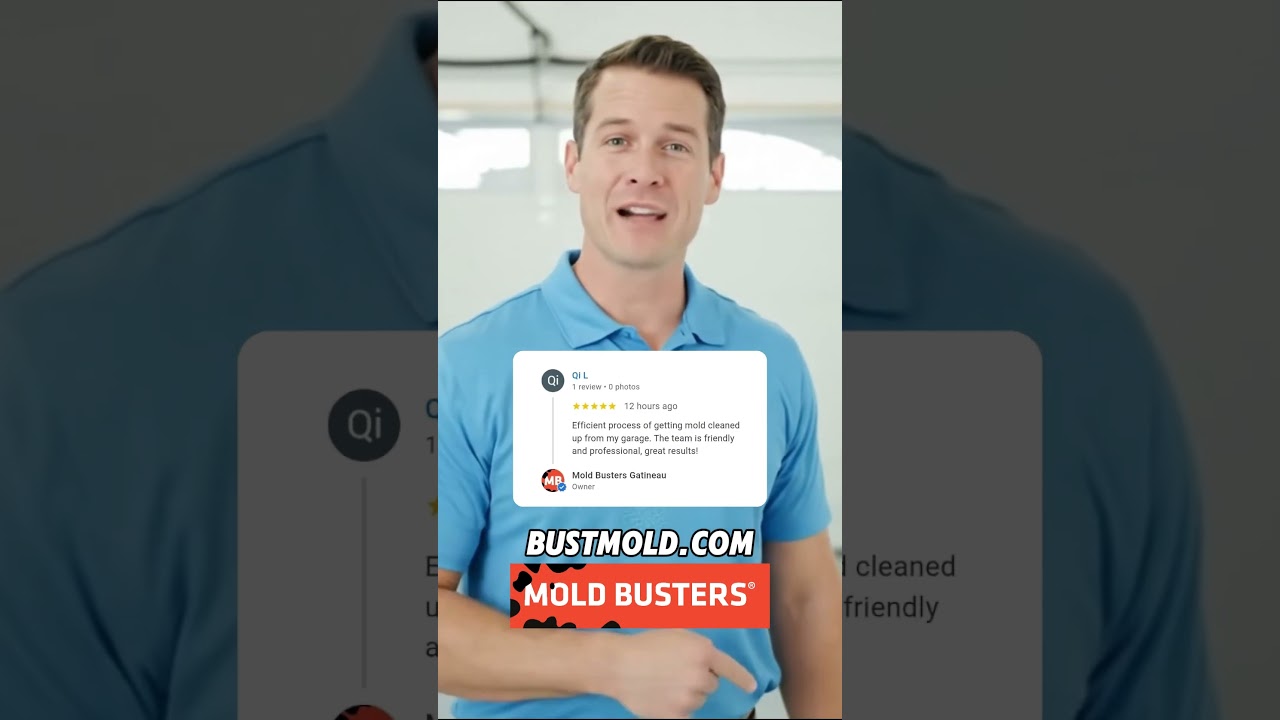
Three of our customers describing the work in their own words.


Certified and accountable
IICRC certified, RBQ licensed in Quebec, NAMP members, and an A+ rating with the Better Business Bureau. The full list is on our certifications page, the people doing the work are on our team page, and our work has been covered by Forbes, CTV News and Global News.
Book Your Free Mold Inspection
Tell us what you are seeing and we will tell you whether it needs an inspection. If it does not, we will say so.
Mold Busters, Ontario and Quebec. Customer service 24/7 on 1-877-566-6653. Inspection and remediation scheduling 8am to 5pm.